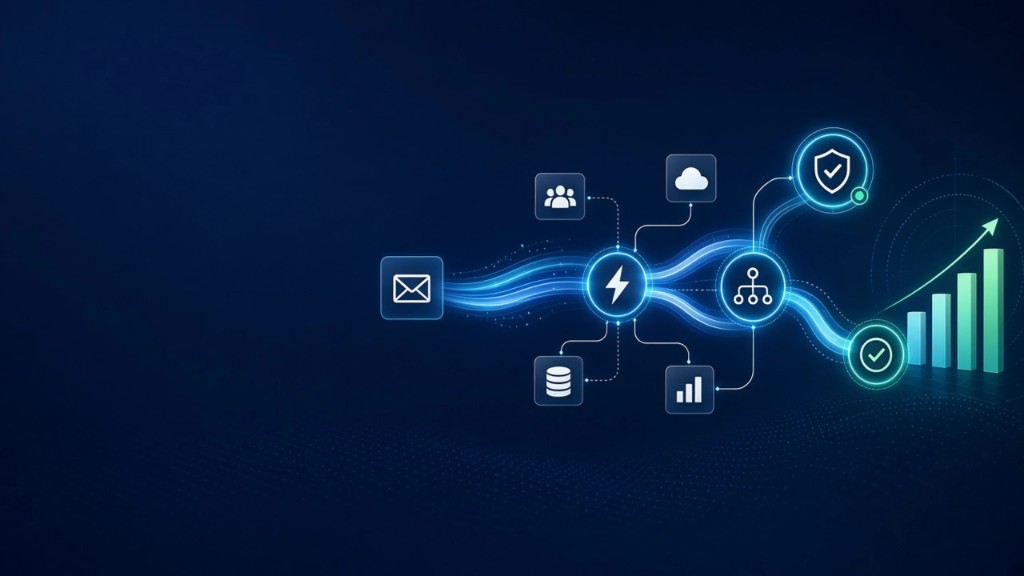
What is intelligent automation? Intelligent automation combines workflow automation, intelligent document processing (IDP), and AI-driven orchestration to handle complex business processes that involve unstructured data, variable inputs, or judgment-based decisions.
Low-code automation platforms work well when inputs are consistent, rules are clearly defined, and processes follow predictable paths. Many business processes do not: they involve unstructured documents, variable formats, exception handling, and decisions that require interpretation rather than rule application.
Intelligent automation addresses this gap by combining workflow orchestration, IDP, and AI-based reasoning.
L1 Process automation
Structured workflows, rule-based routing, and system integration — Power Automate, RPA.
L2 Intelligent document processing
Extraction, classification, and validation that handle unstructured inputs.
L3 Agent orchestration
Multi-step reasoning, decision-making, and exception handling — Copilot Studio, Azure OpenAI.
Governance
Process, data, and AI controls so automation stays auditable in production.
Layer 1: Process Automation
Process automation handles structured workflows — defined triggers, rule-based logic, and predictable data flows. Microsoft Power Automate connects applications, moves data, sends notifications, and executes defined steps. It is strong for approvals, notifications, data synchronisation, and structured form processing. It is not well-suited to variable documents, natural language inputs, or exceptions that require interpretation.
Layer 2: Intelligent Document Processing
IDP applies OCR, NLP, and machine learning classification to extract, classify, and validate structured information from unstructured documents — purchase orders as PDFs, invoices in email, contracts in Word. High-confidence extractions proceed downstream; lower-confidence items route to human review so errors are not propagated at scale.
Layer 3: AI Orchestration and Agents
AI orchestration combines language model capabilities with process automation and IDP to handle multi-step processes with variable inputs and exception handling. An orchestration layer can extract document information, check it against enterprise data with RAG, apply business rules, route exceptions, and act across systems for the majority of cases.
A structured path — L1 foundations, then L2 document intelligence, then L3 agent orchestration — provides a more predictable route to production than introducing agents without data quality, workflow design, and governance.
Where Low-Code Automation Ends
- Structured data: Low-code is strong; intelligent automation is also strong
- Unstructured documents: Low-code is limited; IDP makes intelligent automation strong
- Natural language & context-aware decisions: Supported by intelligent automation, not by traditional low-code alone
- Exception handling: Rule-based in low-code; AI-assisted in intelligent automation
A layered implementation approach — L1 first, then L2, then L3 — provides a more predictable path to production than starting with agents alone.
DesIDEA's Approach
Discover & Assess
Map process complexity, document volume, and where rules stop being enough.
Design & Build
Use Power Automate for L1, IDP for documents, and Copilot Studio / Azure OpenAI for L3.
Integrate & Govern
Define confidence thresholds, exception paths, and audit trails before scale-up.
Continue the cluster: Enterprise AI · AI & Automation Strategy