Trusted data foundations
Ingestion, lakehouse, governance, and analytics-ready datasets for BI and AI.
DesIDEA designs, builds, and supports Azure data platforms and enterprise integrations so information moves accurately, securely, and on time — from lakehouse and Fabric foundations to Logic Apps, APIs, and production monitoring. Backed by 5 projects delivered into production with measurable outcomes. Choose a focus below; the page experience stays consistent for both services.
Ingestion, lakehouse, governance, and analytics-ready datasets for BI and AI.
ERP, CRM, HR, and marketplace flows with validation, retries, and observability.
Key Vault, RBAC, lineage, and audit-ready patterns from day one — not bolted on later.
Reusable frameworks and proven methodology from discovery through optimization and support.
 Azure Data FactoryETL/ELT orchestration across 100+ sources
 ADLS & FabricScalable lakehouse storage and analytics
 Synapse & DatabricksLarge-scale processing and warehousing
 Microsoft PurviewCatalog, lineage, and governed access
DesIDEA helps organizations design and build modern data platforms — migrating legacy sources to the cloud, engineering reliable pipelines, and establishing the governed, analytics-ready foundation that BI, reporting, and AI initiatives depend on.
Improve decision-making by ensuring leaders and teams work from accurate, consistent data.
Reduce manual effort and error through automated, repeatable ingestion and transformation.
Scale cost-effectively with cloud-native storage and elastic compute on Azure.
Lay the governed foundation needed to adopt advanced analytics and AI with confidence.
Organizations struggle when raw, siloed sources never become a trusted asset the business can depend on.
Applications, databases, APIs, files, and SaaS platforms hold data in isolation — blocking a single source of truth for BI.
Point-to-point extracts and one-off ETL break under change, schema drift, and growing source volume.
Without cataloging, quality controls, and access policies, data is hard to trust, discover, or audit.
Reporting and ML need timely, well-structured, governed datasets — not messy raw inputs.
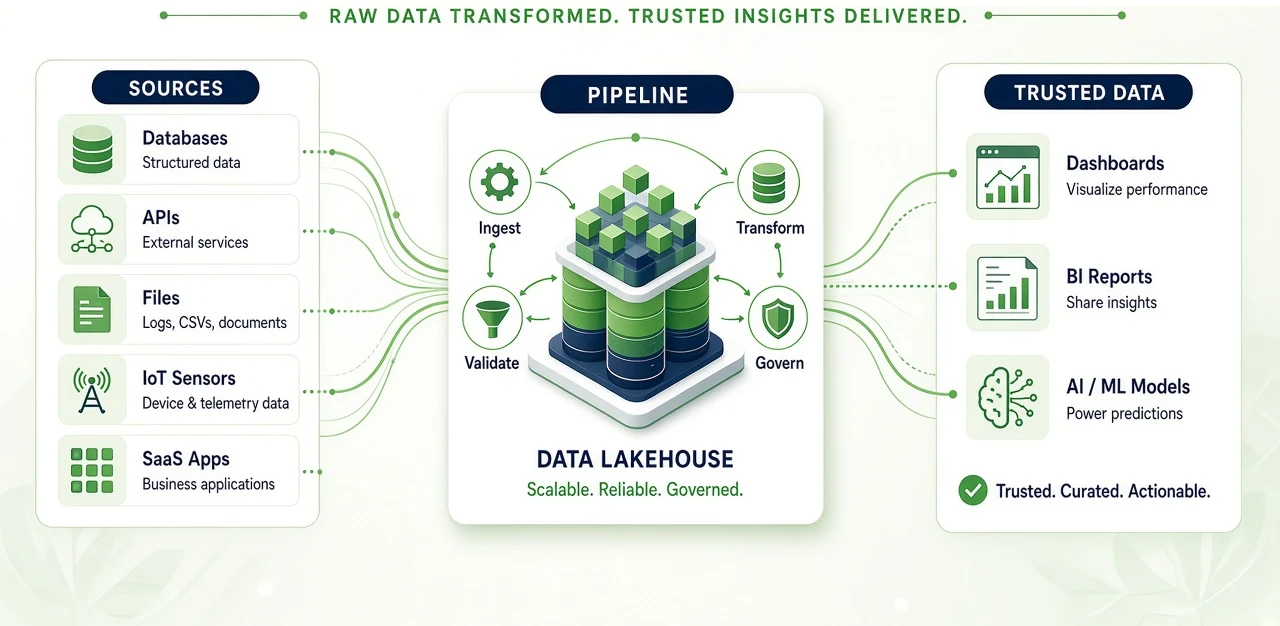
Data engineering is the discipline of designing, building, and operating the systems that collect, move, store, and prepare data so analytics, reporting, and AI/ML can run on trustworthy, timely, and well-governed information.
DesIDEA helps organizations design and build modern data platforms — migrating legacy sources to the cloud, engineering reliable pipelines, and establishing the governed, analytics-ready foundation that BI, reporting, and AI initiatives depend on.

From a single source of truth to AI-ready datasets — grounded in DesIDEA’s data engineering capability overview.
Centralizing data from multiple business systems into a single source of truth for reporting and BI.
Powering real-time dashboards and operational analytics for fraud detection, logistics, or customer experience.
Preparing clean, feature-rich datasets to train and deploy machine learning and AI models.
Enabling regulatory and financial reporting with auditable, governed data pipelines.
Supporting data migration and modernization from legacy systems to cloud platforms.
Enabling self-service analytics by making trusted data easily discoverable across the organization.
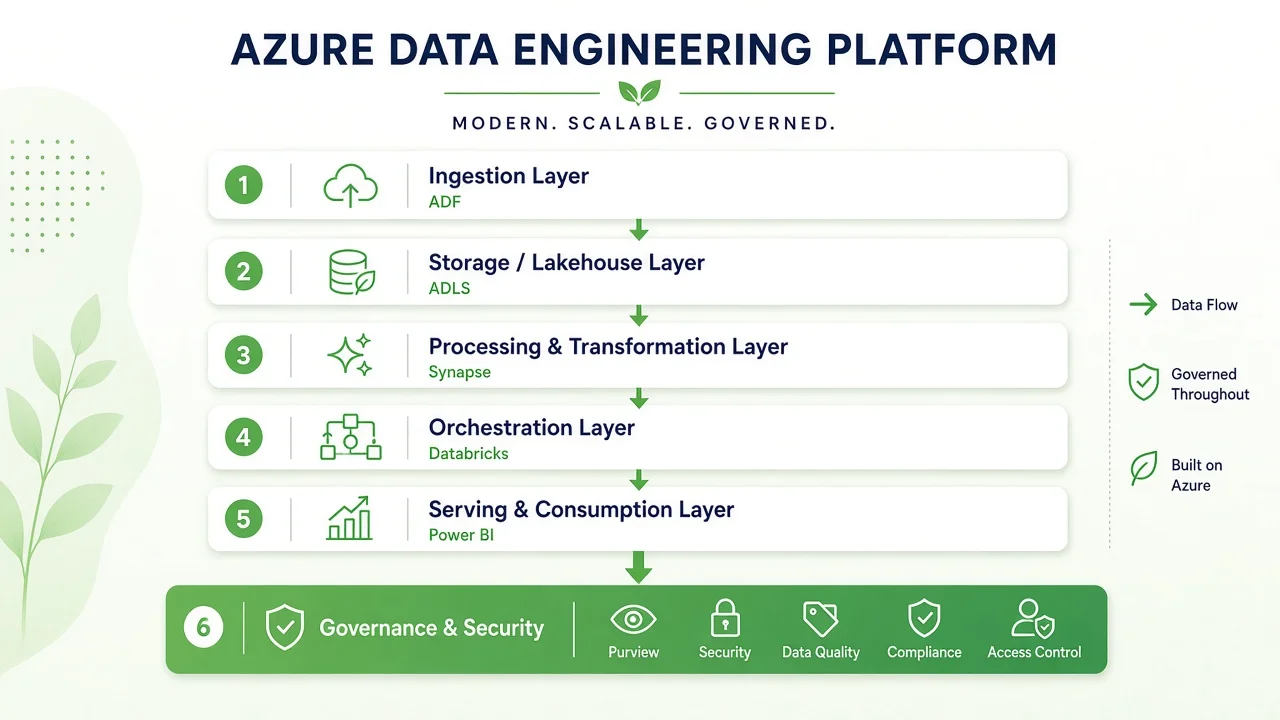
Microsoft Azure offers an integrated suite for modern data engineering — from ingestion and storage to large-scale processing, orchestration, and analytics.
Anchored by Azure Data Factory, Azure Synapse Analytics, Azure Databricks, and Azure Data Lake Storage — with Microsoft Fabric, Purview, and Power BI — we build secure, scalable, enterprise-grade data platforms entirely within the Microsoft cloud.
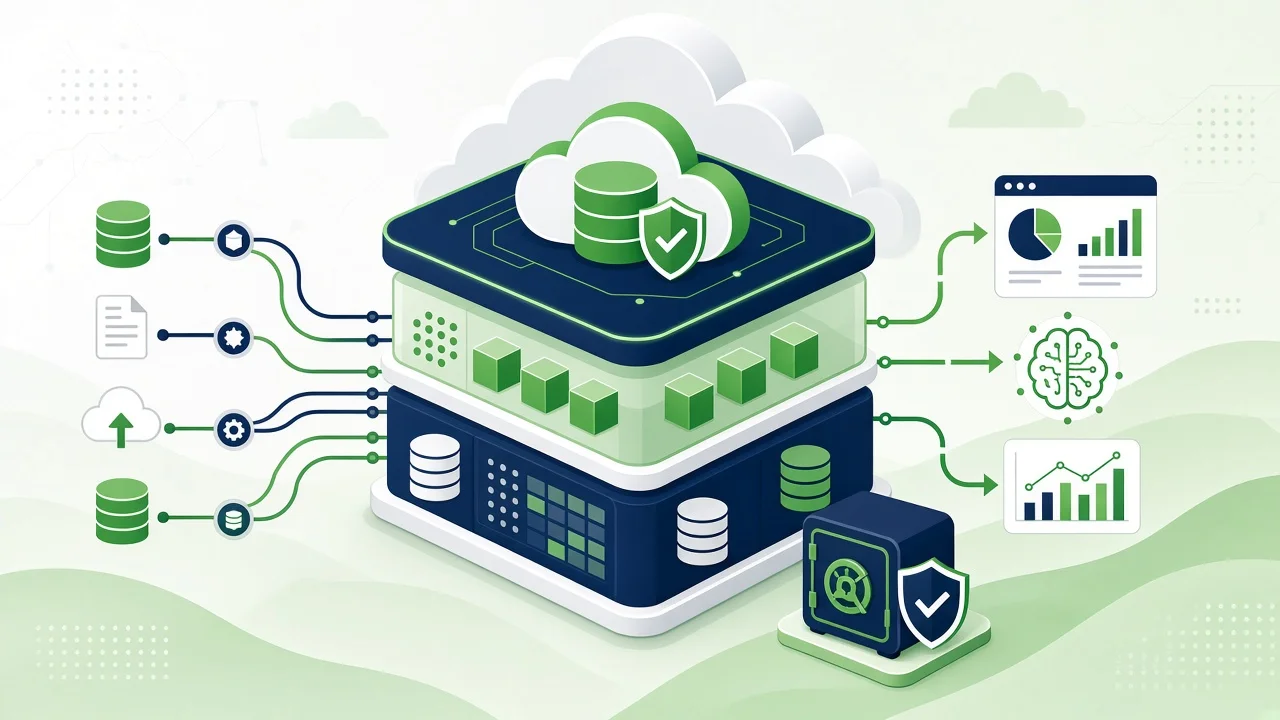
A connected Azure ecosystem for ingestion, lakehouse storage, processing, governance, and BI.
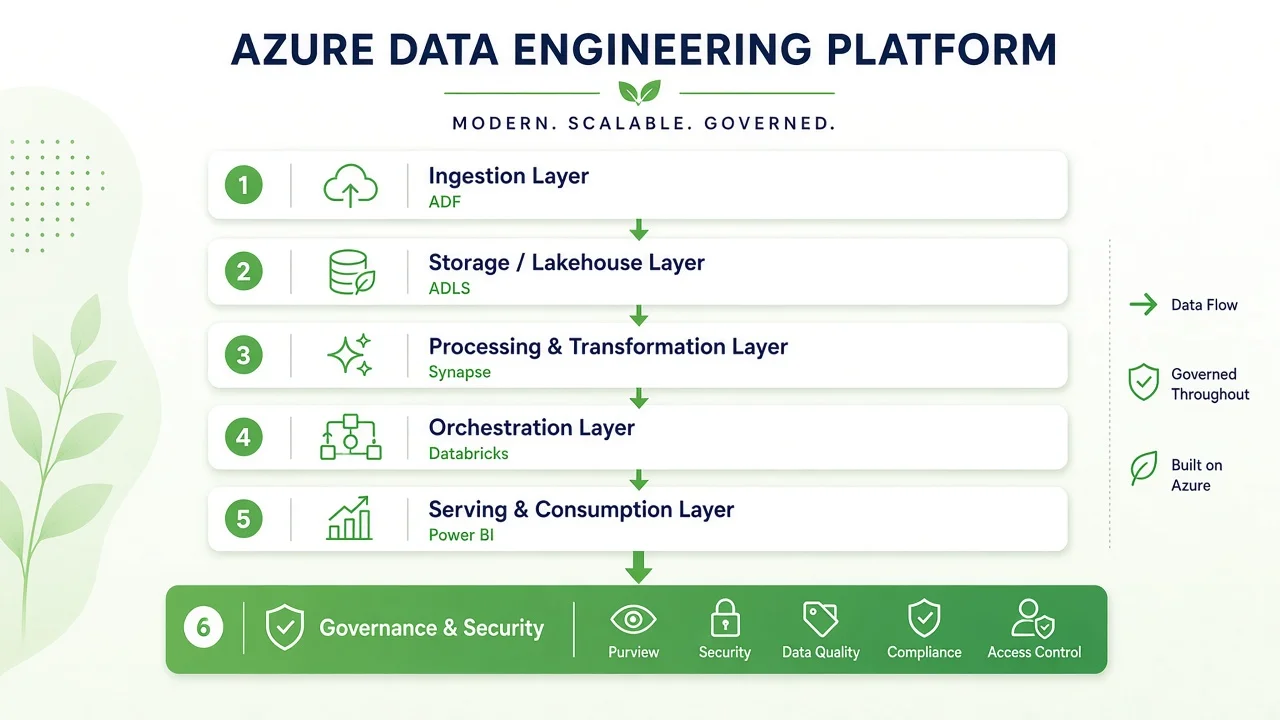
Unified architecture connecting ingestion, storage, transformation, orchestration, governance, and consumption.
Cloud ETL/ELT and orchestration connecting 100+ sources and automating complex workflows.
Highly scalable repository for raw and curated data — lakehouse patterns for batch and real-time.
Unified analytics combining big-data processing, warehousing, and BI in one workspace.
Apache Spark–based platform for large-scale engineering and machine learning workloads.
Real-time ingestion and processing of streaming and IoT data.
Enterprise governance, cataloging, lineage, and native visualization on curated Azure data.
A practical DesIDEA brochure on governed lakehouse platforms, pipelines, orchestration, quality gates, and analytics-ready data for BI and AI — so your Azure data estate is built to operate, not just demo.
Designed for
A consistent, proven path from discovery through ongoing optimization.
Map sources, flows, volumes, quality issues, and outcomes
Evaluate complexity, readiness, options, risk, and value
Define architecture, metadata, security, and success metrics
Implement pipelines, transforms, storage, and orchestration
Test quality, reconcile counts, verify security and acceptance
Release with docs, monitoring, training, and support ownership
Refine performance, cost, quality rules, and new use cases
Leaders and teams work from accurate, consistent data instead of conflicting reports.
Reduce manual effort and error through automated, repeatable ingestion and transformation.
Deep native integration across Azure, Microsoft 365, and Power Platform accelerates delivery and adoption.
Azure AD / Entra ID, RBAC, and unified governance via Purview — built in from day one.
ADLS + Delta Lake via Databricks or Synapse unify batch and real-time workloads.
Shorten the path from raw data to usable information for BI, reporting, and AI.
We connect data engineering to legacy databases, SAP and enterprise apps, APIs, and cloud platforms — not as an isolated technical exercise.
Hands-on experience building metadata-driven ingestion frameworks and Raw → Clean → Business-ready warehouses on Azure.
Data Factory, Synapse, Databricks, Data Lake Storage, API Management, Key Vault, and Logic Apps — delivered end to end.
Centralized secrets, RBAC, encryption, and auditable lineage — not retrofitted after go-live.
Credentials resolved from Azure Key Vault at runtime. Role-based access and encryption at rest and in transit protect sensitive data.
Microsoft Purview establishes governance, cataloging, and lineage as the platform scales — so data stays discoverable and trustworthy.
Automated testing, monitoring, and alerting catch data quality issues early — with Azure Monitor and Cost Management for predictable spend.
Data engineering designs, builds, and operates the systems that collect, move, store, and prepare data so analytics, reporting, and AI/ML can run on trustworthy, timely, and well-governed information.
Core services include Azure Data Factory, Azure Data Lake Storage Gen2, Azure Synapse Analytics, Azure Databricks, Azure Stream Analytics / Event Hubs, Microsoft Purview, Microsoft Fabric, and Power BI — with Key Vault and API Management for security and governed ingestion.
We follow a seven-step methodology: Discover, Assess, Design, Build, Validate, Deploy, and Optimize — covering source mapping through production monitoring and platform expansion.
Metadata-driven on-premises-to-cloud lakehouse migration (ADLS, Databricks, APIM, Key Vault, Logic Apps) and layered Raw → Clean → Business-ready warehouses on Azure Synapse and ADF.
Microsoft Fabric unifies lakehouse storage and analytics workloads alongside ADLS Gen2, Synapse, and Databricks — so batch and real-time data can land in a governed estate and feed Power BI and AI use cases.
Secrets resolve from Azure Key Vault, access uses RBAC / Entra ID, and Microsoft Purview establishes cataloging and lineage. Encryption at rest and in transit, quality checks, and monitoring are designed in from day one.
Yes. A common engagement pattern is migrating on-premises SQL Server and hand-built ETL to Azure-native services — Data Factory or Synapse Pipelines for orchestration, ADLS for landing zones, and Synapse or Databricks for transformation and warehousing.
Download the Azure Data Engineering brochure for the platform checklist, or contact us to talk with a Data Engineering Expert about your sources, analytics goals, and first delivery slice.
Share your source systems and analytics goals. We will map a practical Azure data platform path — from ingestion and lakehouse design through governance and AI readiness.
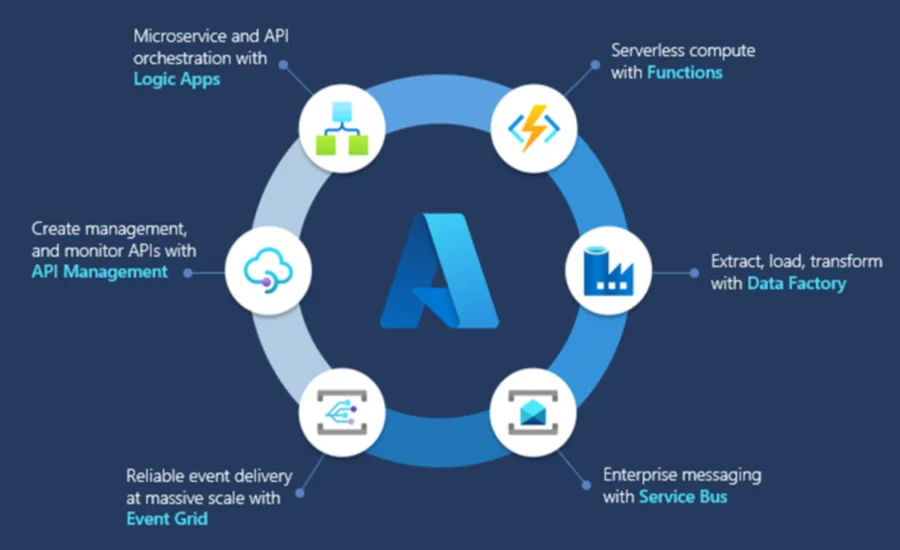 Azure Logic AppsWorkflow orchestration across systems
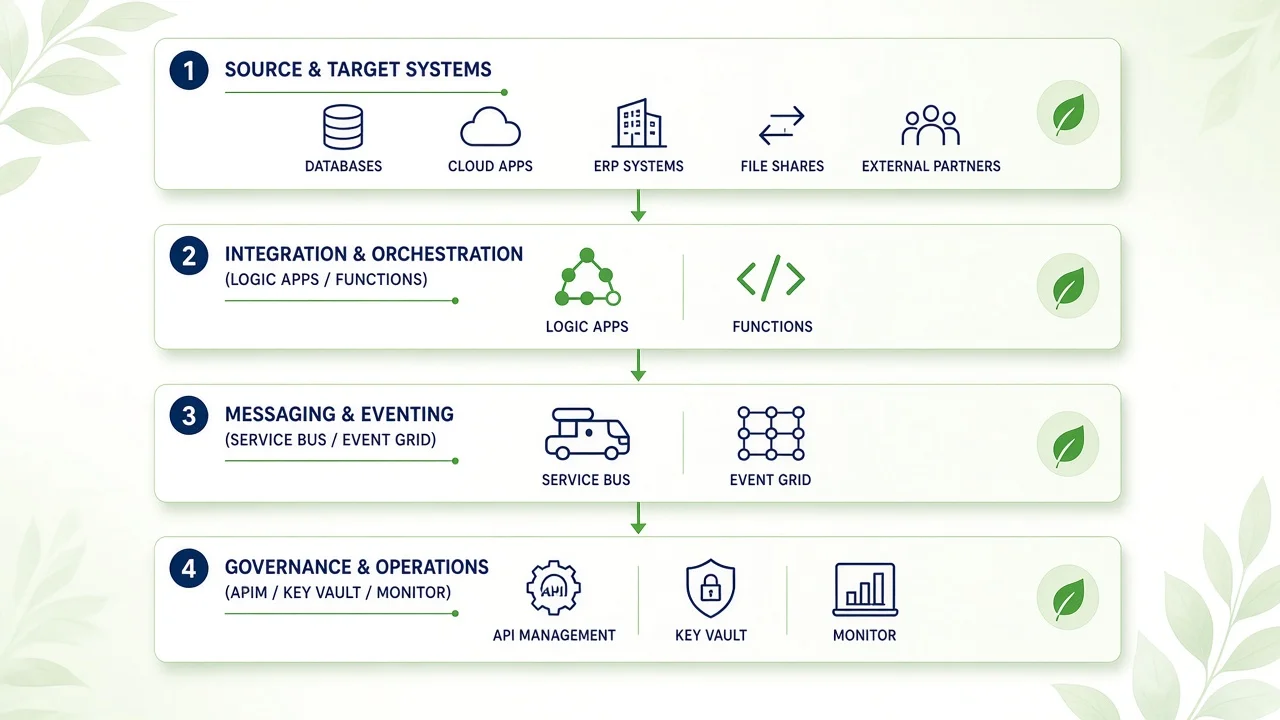 API ManagementSecure, governed API exposure
 Service BusReliable, decoupled messaging
 Key Vault & MonitorSecrets, observability, and alerts
Reduce time spent re-keying or reconciling data between systems.
More consistent order, shipment, and employee-data processing across connected systems.
Validation at the point of transfer stops bad data before it reaches downstream systems.
Structured logging and transaction tracing make root-cause analysis faster when something fails.
Most enterprises run ERP, CRM, HR, e-commerce, logistics, and partner platforms that all need to exchange information — without silent failures.
Business data moves through manual export/import or duplicate entry instead of governed application-to-application flows.
Without retries, monitoring, and correlation IDs, integration breaks are discovered downstream — too late.
External APIs and payload formats change; unmanaged integrations break order and shipment flows.
Cloud apps must bridge on-premises and legacy systems where modern APIs are not available.
Azure Integration is the discipline of connecting systems so data and business events flow between them automatically, accurately, and securely — combining Logic Apps, API Management, Service Bus, Event Grid, Azure Functions, and Data Factory into a coherent integration layer.
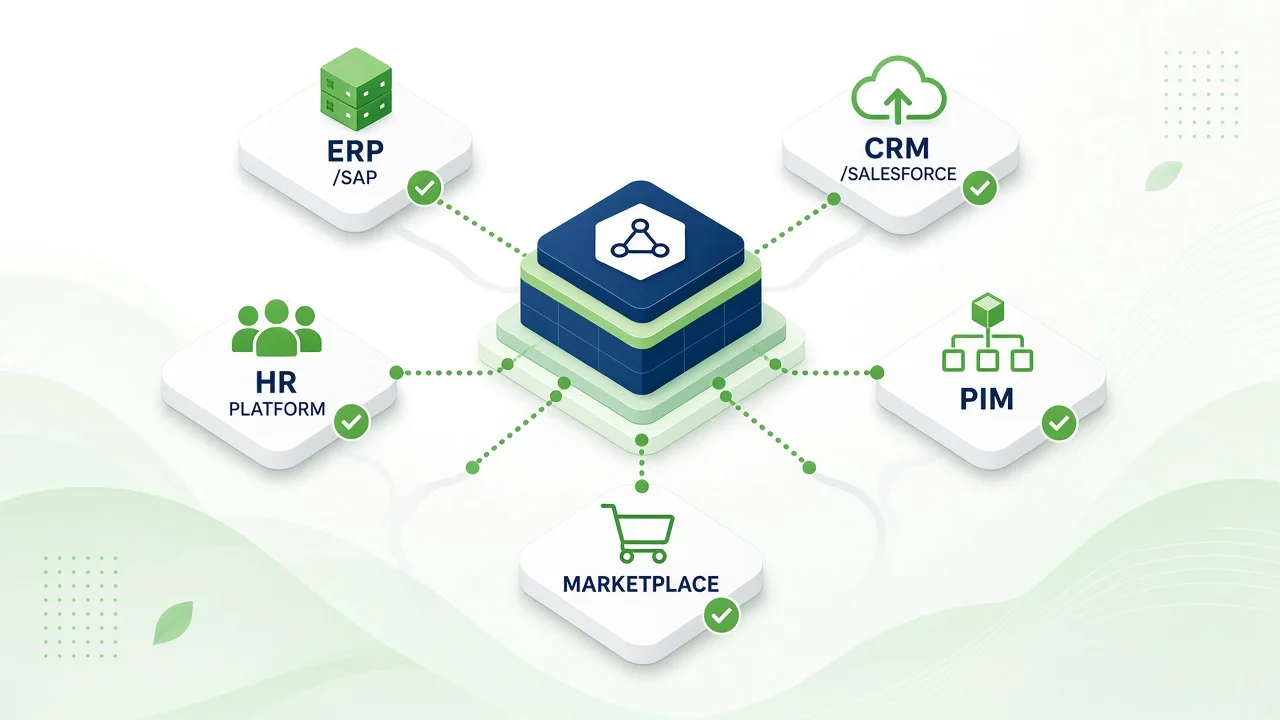
DesIDEA designs, builds, and supports Azure-based integrations that connect enterprise applications and data — enabling reliable, secure, and auditable automation of business-critical information flows between systems such as SAP, Salesforce, HR platforms, and e-commerce marketplaces.
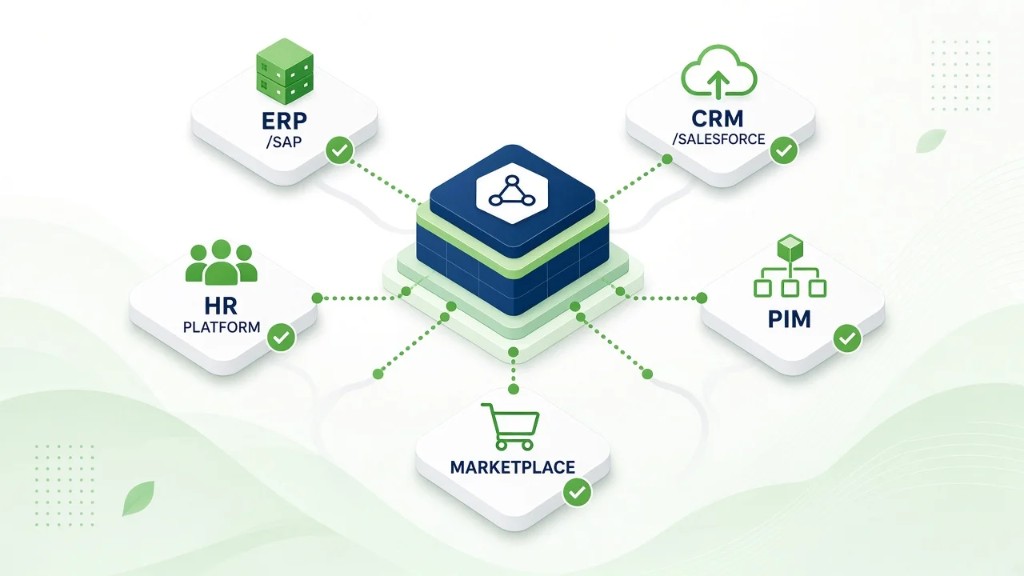
DesIDEA connects the systems your business runs on through production-grade Azure integrations. We design for the failures that happen in production — volume spikes, partner payload changes, and downstream outages.
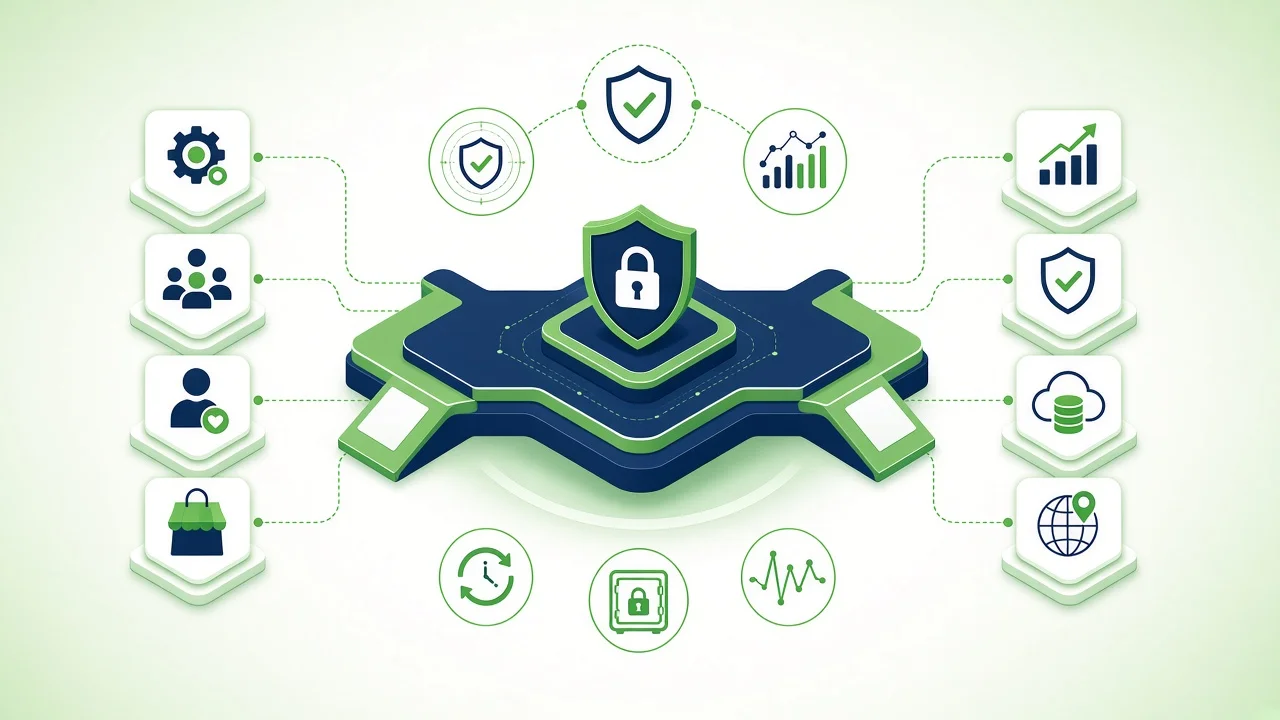
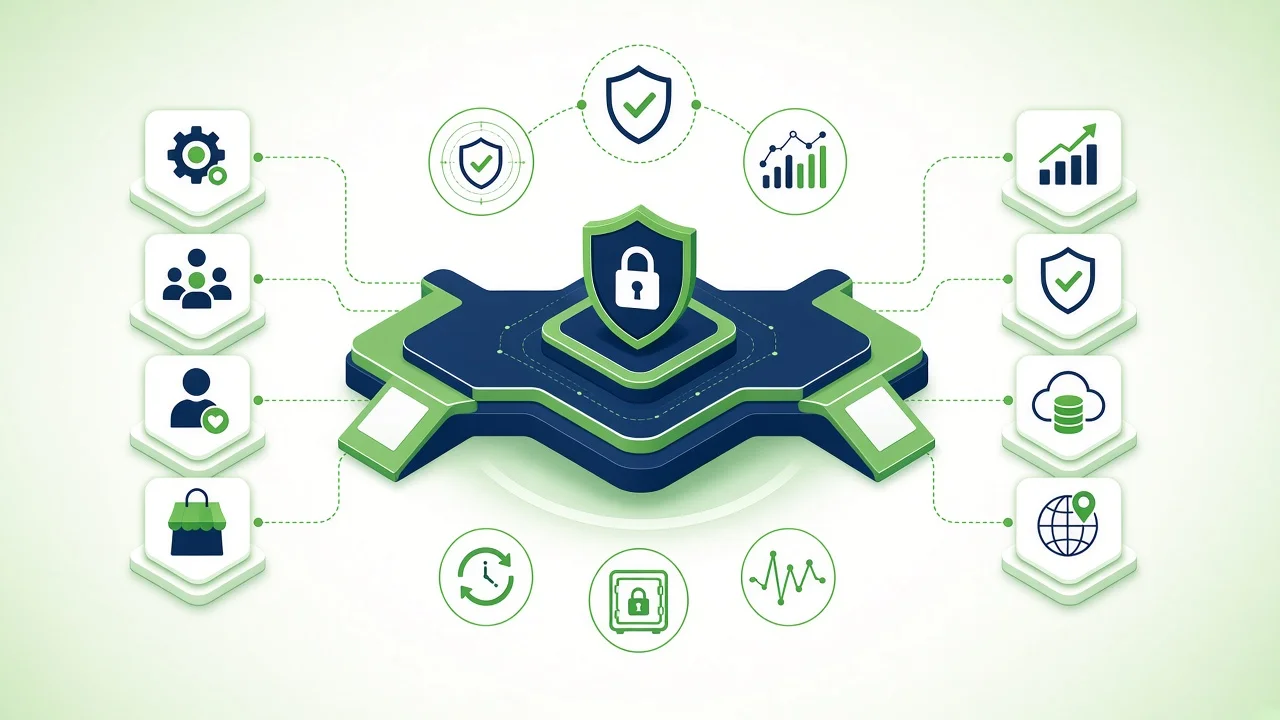
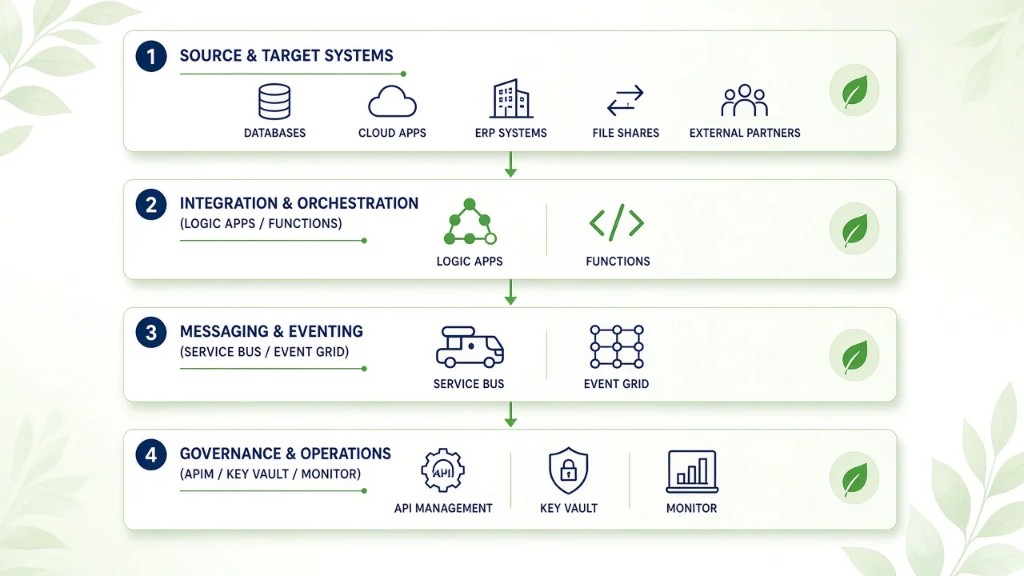
A typical DesIDEA Azure Integration solution is organized into four layers that work together: Source & Target Systems, Integration & Orchestration, Messaging & Eventing, and Governance & Operations.
Eight capability pillars aligned with DesIDEA’s delivered project experience.
A coherent integration layer between ERP, CRM, HR, e-commerce, and partner systems — with validation and observability built in.
Connect enterprise applications (ERP, CRM, HR, e-commerce) directly, so business data moves without manual export/import or duplicate entry.
Reshape and validate data between source and target schemas, applying business rules before data reaches downstream systems.
Keep two or more systems consistent as records change on either side — orders, shipments, employee records, and more.
Move larger volumes of data on a defined schedule where real-time sync is not required, using efficient batch patterns.
Trigger downstream actions the moment a business event occurs, reducing latency between systems.
Exchange orders, shipments, and confirmations with external partners and marketplaces through governed, monitored flows.
Recover from transient failures automatically and support safe reprocessing without creating duplicates.
Run history, correlation IDs, and alerting — plus end-to-end support for production issues.
High-value enterprise scenarios from DesIDEA’s Azure Integrations blueprint.
Product and catalog sync to CRM, order and opportunity exchange, and customer master data alignment across systems.
Employee data distribution from a core HR system to travel, expense, recruiting, and payroll/ERP — including new-hire and termination events.
Bi-directional order integration with ERP, shipment status back to the marketplace, and exception handling for rejected orders.
Bi-directional order and shipment-detail sync with SAP, master-data alignment, and cross-system reconciliation.
Order and invoice reconciliation, duplicate-safe reprocessing for financial transactions, and audit-ready transaction logs.
Catalog and attribute sync to sales/CRM platforms, validation before downstream load, and change propagation from the source.
A DesIDEA brochure on governed Azure connectivity — Logic Apps, APIs, messaging, validation, retries, and monitoring — so ERP, CRM, HR, PIM, and commerce systems exchange data reliably in production.
Designed for
From business process discovery through production go-live.
Understand processes, systems, volumes, and pain points
Define pattern, mapping, and error-handling approach
Implement with Logic Apps, Functions, Service Bus, and related services
Validate with real data, edge cases, and failure scenarios
Go live with monitoring, alerting, and access controls verified
One-way product data integration with mapping, validation, transformation, and structured error handling.
Dayforce to AmTrav, Concur, iCIMS, and SAP — each with distinct mapping requirements.
Bi-directional Walmart–SAP integration for inbound orders and outbound shipment updates.
Bi-directional SFOMS–SAP sync keeping orders and shipment details consistent.
Enterprise integrations touch sensitive data — governance is a first-class part of delivery.
Managed identities and RBAC scope what each integration can read or write. Credentials live in Azure Key Vault — never hard-coded.
Retries, timeouts, circuit breakers, correlation IDs, and duplicate-safe reprocessing so failures are contained and recoverable.
Versioned mapping logic with rollback paths. Failed transactions captured with enough context to investigate and reprocess safely.
Honest delivery guidance from the Azure Integrations blueprint — so expectations stay realistic.
Integration quality depends on the quality of source data — a well-built integration cannot fully compensate for a poorly maintained source system.
Real-time integration adds architectural complexity compared to simple batch/scheduled transfers, and should be used where the business case justifies it.
Partner-side changes (a marketplace changing its API or payload format) can break an integration if not monitored and versioned carefully.
Integrations that touch multiple systems require coordinated change management, since a change on one side can affect several downstream consumers.
Azure Integration connects applications, data, and partners using Azure services such as Logic Apps, API Management, Service Bus, and Event Grid — so information moves accurately, securely, and on time.
Logic Apps for orchestration, Azure Functions for custom logic, API Management for governed APIs, Service Bus and Event Grid for messaging and events, Data Factory for large-scale movement, plus Key Vault and Azure Monitor / Application Insights for secrets and observability.
Discover → Design → Build → Test → Deploy — with validation and logging built in from the start, and production issues traced using run history and correlation IDs.
Secrets are managed in Azure Key Vault. Integrations use managed identities and RBAC, retries and circuit breakers on external calls, transaction/correlation IDs for tracing, and duplicate-safe reprocessing.
One-way sync (e.g. PIM → Salesforce), one-to-many distribution (e.g. Dayforce → AmTrav, Concur, iCIMS, and SAP), and bi-directional sync (e.g. Walmart ⇄ SAP and SFOMS ⇄ SAP) — each with validation, error handling, and monitoring as standard.
Use real-time or event-driven flows when business events must propagate quickly (orders, status changes, new hires). Prefer batch or scheduled movement for larger volumes where near-real-time is not required — real-time adds complexity and should be justified by the business case.
Yes. DesIDEA builds governed Azure integrations across ERP (including SAP), CRM (including Salesforce), HR platforms (including Dayforce), e-commerce marketplaces, and PIM systems — using Logic Apps, Functions, Service Bus, Event Grid, and API Management.
Download the Azure Integrations brochure for the connectivity checklist, or contact us to talk with an Azure Integrations Expert about the systems you need to connect.
Tell us which systems need to exchange data. We will outline the right Azure integration pattern — Logic Apps, APIs, messaging, and monitoring — for reliable, auditable flows.