What is the difference between AI and automation? Automation executes defined processes — it follows rules, moves data, and triggers actions based on conditions specified in advance. AI recognises patterns, interprets language, and makes decisions based on context. Automation is deterministic; AI is probabilistic.
These are distinct capabilities that address different problems — and conflating them leads to poor technology decisions. Organisations that deploy AI where automation would suffice, or try to automate processes that require AI-level reasoning, consistently encounter over-complexity, cost, under-capability, or failure at edge cases.
The more productive question is not which to choose, but how they work together — because the most effective enterprise solutions combine both.
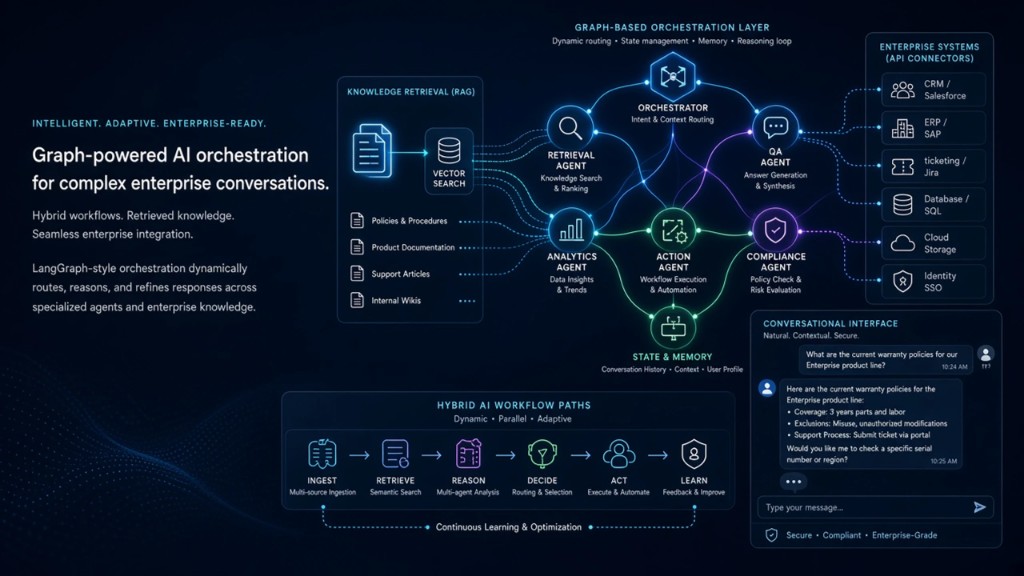
L1 Process automation
Structured rules, defined triggers, and system integration with Power Automate.
L2 Document intelligence
Extraction, classification, and validation of unstructured documents.
L3 Agent-based AI
Multi-step reasoning, orchestration, and exception handling with Copilot Studio and Azure OpenAI.
Enterprise integration
Connect AI and automation to ERP, CRM, APIs, and identity through Entra ID.
AI vs Automation: The Core Distinction
Automation is process execution. It reliably executes what it has been told to do, on the data it receives, in the order specified. It does not interpret ambiguous inputs, handle unexpected formats, or make decisions not covered by its rule set.
AI is pattern recognition and reasoning. It interprets inputs — including natural language, unstructured documents, and ambiguous context — and produces outputs based on learned patterns and contextual reasoning. It is not inherently reliable for rule-based process execution: its outputs are probabilistic, which makes it unsuitable for tasks requiring 100% consistent, auditable rule application.
How They Work Together: An Invoice Example
- Document receipt: Automation detects the email, extracts the PDF attachment, and routes it to the processing pipeline.
- AI extraction (IDP): AI reads the PDF and extracts vendor, invoice number, line items, amounts, and due date — regardless of layout.
- Validation: Automation checks values against the purchase order in ERP; AI evaluates discrepancies and flags risk.
- Routing: High-confidence matches proceed to payment scheduling; exceptions go to human review with AI context.
- Processing: Automation executes the ERP payment action and updates accounts payable.
Neither AI nor automation alone handles this process effectively. Together, they handle both interpretation and execution.
When to Use AI, Automation, or Both
- Automation (L1): Move approved data between systems on a schedule — deterministic and auditable.
- IDP (L2): Process variable-format documents at scale and extract structured data.
- AI (RAG): Answer employee questions using internal policies and organisation-specific knowledge.
- AI + Automation: Handle customer enquiries end-to-end or orchestrate multi-step processes with exceptions.
Enterprise value is delivered when AI and automation are connected to the systems where business data and processes reside — not left as disconnected pilots.
DesIDEA's Approach
Discover & Assess
Understand the business process, data environment, technical fit, and risk before committing architecture.
Design & Build
Combine L1 automation, L2 document intelligence, and L3 agents where each layer earns its place.
Integrate & Govern
Connect enterprise systems, deploy with controls, and monitor outcomes for production sustainability.
Explore the cluster: Enterprise AI · Intelligent Automation