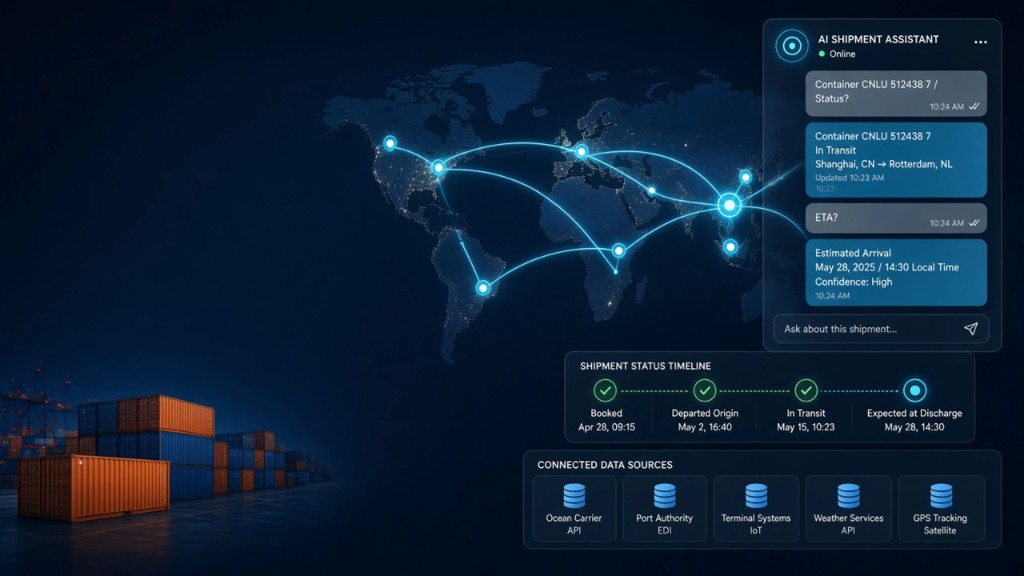
What is enterprise AI? Enterprise AI applies large language models, AI agents, retrieval-augmented generation, and machine learning to business processes, data environments, and decision workflows. Unlike consumer AI, it requires integration with existing systems, governance, security controls, and the ability to operate at scale.
Most organizations have run AI experiments. The challenge is rarely finding a model or a use case — it is moving AI from a disconnected pilot into a production environment where it connects to business data, integrates with enterprise systems, operates within governance boundaries, and delivers measurable value consistently.
Why Enterprise AI Is Different
- It must connect to enterprise data. Useful answers depend on product data, customer records, contracts, policies, and operational systems.
- It must integrate with enterprise systems. ERP, CRM, document repositories, APIs, and workflow tools turn answers into action.
- It must operate within governance and security. Data residency, access control, audit obligations, and risk frameworks are non-negotiable.
LLMs & generative AI
Managed cloud endpoints for language understanding, structured outputs, and task completion.
RAG
Ground responses in current, organisation-specific knowledge instead of general training data alone.
AI agents
Extend LLMs from answering questions to multi-step action across approved tools.
Enterprise platforms
Copilot Studio, Azure OpenAI, and SAP Joule for governed deployment paths.
Core Capabilities
Retrieval-Augmented Generation (RAG) retrieves relevant enterprise content at query time and provides it to the model as context, enabling responses that reflect current proprietary knowledge.
AI agents combine a language model with APIs, databases, enterprise applications, and workflow triggers so they can plan and execute multi-step tasks — for example checking an order system, updating CRM, and triggering follow-up.
Microsoft Copilot Studio and Azure OpenAI Service provide enterprise-grade agent building, RAG, security, and identity integration through Microsoft Entra ID. SAP Joule embeds contextual AI assistance inside SAP workflows without leaving the SAP environment.
Where Enterprise AI Delivers Value
- Customer service automation — answers using product and order data; escalates where needed
- Document processing — extract, classify, and validate structured data from unstructured documents
- Knowledge retrieval — answer employee questions from policies, contracts, and documentation
- Process orchestration — coordinate multi-step tasks across systems with natural-language instructions
- Supply chain intelligence — operational answers from real-time logistics and inventory data
Governance is not a constraint on AI capability — it is the operational foundation that makes enterprise AI deployable and sustainable.
DesIDEA's Approach
Discover → Assess
Understand the business process, data environment, technical fit, and risk.
Design → Build
Design integration architecture, then build and test the production solution.
Integrate → Govern
Connect enterprise systems, deploy with controls, and establish ongoing monitoring.
Continue the cluster: Intelligent Automation · AI & Automation Strategy